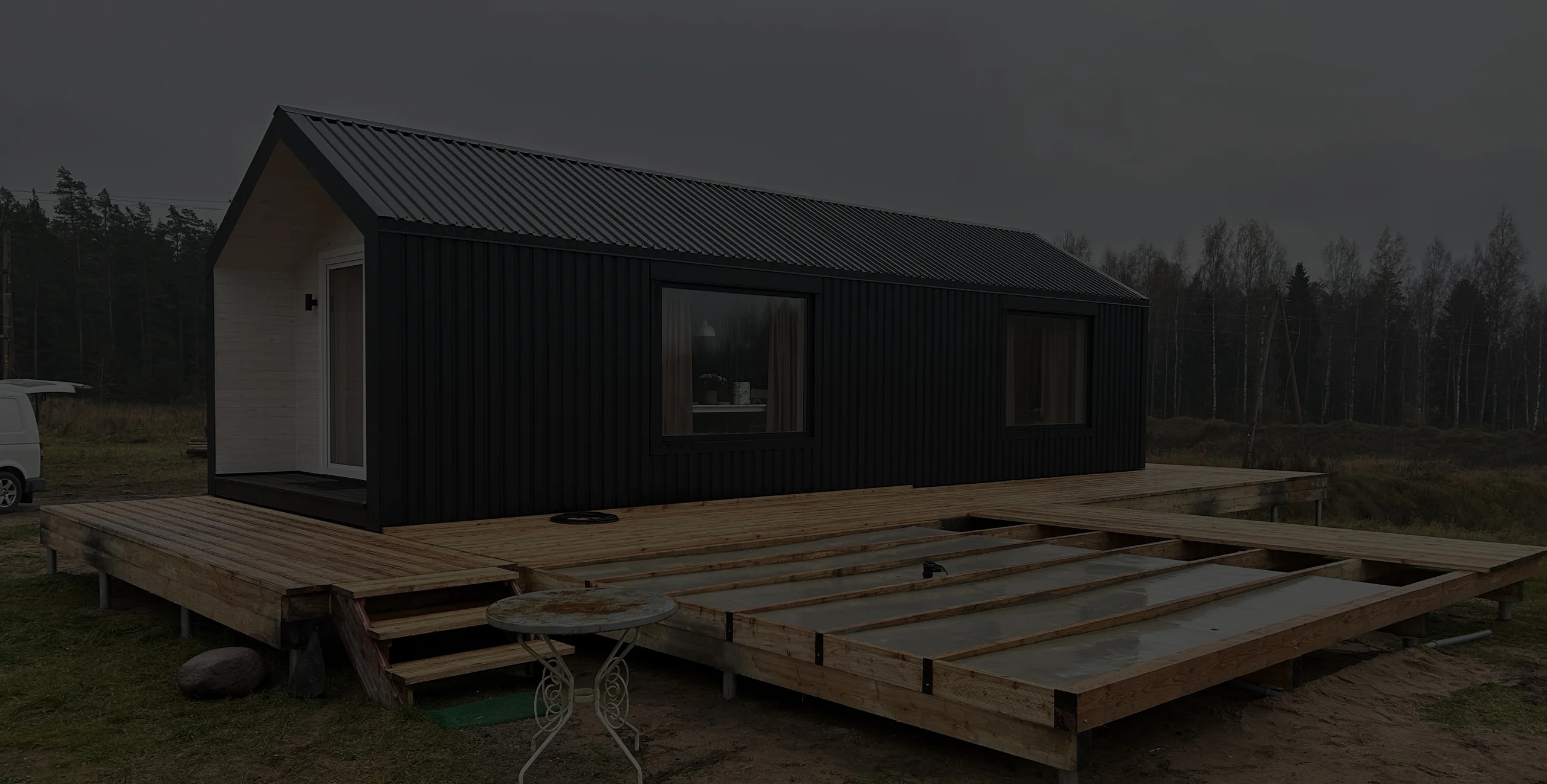
Common mistakes when choosing foundations
The building’s foundation carries its entire weight. Mistakes in choosing it later cost thousands of euros as walls begin to crack or floors settle.
Decisions are often made by guessing or trying to save money, rather than being based on the actual situation on site. Let’s look at the main mistakes made at the beginning of construction.
Not knowing the soil condition
Whether you choose concrete or screw pile foundations, everything is determined by the soil composition. Starting work without a site investigation is a major mistake.
What happens if this step is skipped:
- foundations are built on soft peat
- the building starts to settle over time
- the solid soil layer is not reached
Knowing the soil composition allows us to accurately choose the required length of the metal supports and reach the dense ground layer.
Incorrect building weight calculation
Often, foundations are calculated only for the weight of the timber frame.
What must be taken into account:
- roofing
- interior finishing and furniture
- winter snow load
If the actual load is greater than planned, concrete begins to crack, and metal supports bend. The full mass of the building must always be evaluated to choose the appropriate screw pile diameter.
Too much distance between supports
Trying to save on materials, owners often place supports three or four meters apart.
What are the consequences:
- wooden beams cannot withstand the heavy load
- floors and walls sag
- windows and doors start to jam
Supports must be installed at a precise distance, taking into account the load-bearing capacity of the frame materials.
Using unsuitable materials
Choosing the cheapest materials will always result in a short-lived outcome.
Why is this dangerous:
- untreated metal quickly rusts in wet ground
- thin-walled pipes cannot withstand the load
- manual screwing does not reach the necessary depth
For a high-quality result, hot-dip galvanized supports and hydraulic equipment that precisely embeds the screw pile to the required depth must be used.
Conclusion
The right decision is always based on the specific site data. To avoid wasting money on incorrect solutions, loads and soil conditions must always be evaluated.
Need a consultation about foundations? Fill out the contact form, and we will help you choose the most suitable solution for your project.